Welcome back to the Kids’ Storyworld blog!
I’m going to get straight into it…
There are so many benefits to reading for pleasure. Better life outcomes, reduced stress, improved empathy, stronger communication skills, enhanced critical thinking, keeping brains mentally active… the list goes on and on.
But honestly, the biggest benefit is that reading can be FUN.
There is one huge caveat though…
It is only fun if the reader gets to choose.
Imagine this scenario…
You’ve got ready for a rare night out. The babysitter’s sorted (maybe your mum), you’ve put on your favourite outfit and you’re feeling a million dollars. You’re wearing your favourite green top or shirt. The one that always makes you feel good.
You head downstairs.
Your mum looks you up and down.
“You’re not wearing THAT again, are you? It looks so unelegant. Basic. I like mauve. I thought this might happen, so I’ve brought my favourite mauve top for you to wear. If you want me to babysit, you MUST wear this. I’m so sick of you wearing that green top. I don’t like it. It makes you look sallow. And what’s with the shape of it? I like mauve, so you need to wear this top. I want what’s best for you and that means wearing the top I’ve chosen.”
So you wear the mauve top to keep her happy.
You hate mauve.
Now you don’t feel comfortable in the green top either. Maybe she’s right? Maybe it does look awful? You’re embarrassed by it now.
You like the mauve top even less.
You don’t wear either top again.
And frankly, you don’t really feel like going out anymore.
Extreme, right?
Or is it?
The number of times I’ve asked children what they enjoy reading for pleasure and heard, “Dog Man. I love it, but my grown-up says it’s not a proper book,” is honestly heartbreaking.
Or listened to well-meaning parents say, right in front of their child, “They don’t read proper books. Only Dogman.”
The look on the children’s faces gets me every time. Sometimes it’s only there for a split second, but it’s always there.
And honestly? It truly breaks my heart.
Now before anyone panics, this isn’t parent shaming or parent blaming.
We’re all trying to do what we think is best for our children. Society has spent years telling us that some books have more value than others. That certain books are “proper” reading and others somehow don’t count. Also, it’s important to mention, there’s a huge gap between the authors that parents are aware of and what is actually out there and this doesn’t help.
Reading for pleasure is exactly what it says on the tin: reading because you enjoy it.
Not reading for SATs.
Not reading for literacy targets.
Not reading for exams.
Reading because you enjoy it.
And in this case, that enjoyment should belong to the child.
(As a side note, comics, graphic novels and joke books are absolutely incredible for many children. There are whole articles to be written about why they’re brilliant and the role they play in creating lifelong readers.)
Can we suggest books?
Absolutely.
Should we share books we love?
Of course.
But there’s a world of difference between suggesting and forcing.
Let’s go back to the top situation.
Imagine your well-intentioned mum said this instead:
“WOW! That top looks amazing on you. I love how confident you look in it. My favourite top is this mauve one. If you ever fancy trying it on, you’re very welcome to. I think it might suit you too. You’ve got such great taste — I’d love some suggestions about what I should wear!”
Feels different, doesn’t it?
That’s how we build readers.
Whether it’s a magazine, an audiobook, fiction, non-fiction, comics, chapter books, cookbooks or picture books at ANY age, it must be their choice. That’s not to say we can’t introduce children to new books or share stories we love ourselves. Of course we can. But there’s a world of difference between sharing a recommendation and making a child feel their own choices aren’t good enough.
I think one of the best things we can do is show genuine interest in what they’re already reading. Ask them about it. Let them tell you why they love it. Better still, ask to borrow it.
I tried this with my son when he was going through an A Series of Unfortunate Events phase. I told him I was reading his favourite one and he absolutely BEAMED. Not because I’d praised it or told him it was educational, but simply because I wanted to read something he loved. For a moment, he was the expert and I was taking his recommendation.
Those little moments matter. They tell children that their tastes, opinions and choices have value. They help children see themselves as readers.
After all, as the saying goes, we catch more flies with honey…
My parents always let me choose my own books. No shelf in the house was out of bounds. No aisle in the library was off limits. Not once did they negatively comment on my choices (reading choices anyway!😆). I wanted to pass that same freedom on to my own children.
True story time
When my eldest (now 11) was four years old and still at nursery, I took him to a bookshop. We had one rule: we’d read the blurb together or have a flick through, and if he still wanted the book afterwards, he could have it.
He picked up Varjak Paw by SF Said.
We read the blurb together. I explained a little bit about the story. He still wanted it, so we left the shop with his choice.
I read a couple of chapters to him and he lost interest.
That was that.
Varjak Paw then sat on his shelf for three years.
At around seven years old, he picked it up himself.
And this time it clicked.
He went on to read the rest of the series and listen to the audiobooks too. To this day he’s a huge SF Said fan. In fact, for the last couple of months he’s been listening to Tyger on Audible every single night. I’ve also just got Phoenix, which I’ll be putting on his Kindle soon (e-readers are a topic for another day!).
This perfectly sums up why children’s choices matter. At four years old, he chose a book that wasn’t right for him at that moment. But it was still the right choice, because it was his choice. The book simply waited on the shelf until he was ready for it.
Did I mention that we’re HUGE SF Said fans in this house? I’ve also had the good fortune of seeing SF in action at London Children’s Literature Festival 🔗 – where he’ll be this year too!), so when he kindly agreed to take time out of his busy schedule for this Q&A, I genuinely had to pinch myself.
SF has worked in journalism, film and speechwriting, but today he is one of the most passionate advocates for reading for pleasure and children’s reading rights. One of the aims of this blog is to help parents become more familiar with children’s authors and illustrators, and to showcase the incredible variety of books available to young readers.
His favourite film growing up was Star Wars, and to this day he remains a huge fan of Marvel Comics, as well as a wide range of other comics, graphic novels, and manga.
If anyone ever needed proof that comics are good for children, this is it. The key is giving young readers choice and autonomy. When children are free to explore the stories and formats that genuinely interest them, reading becomes a joy rather than a chore.
Give them that freedom, and they will fly…through the power of their creativity and imagination.
SF Said’s Varjak Paw won the Nestlé Smarties Book Prize, The Outlaw Varjak Paw won Blue Peter Book of the Year, and Tyger won both the British Book Award for Children’s Fiction and Foyles Children’s Book of the Year. His fierce belief that every child can be a reader in their own way is one that should be echoed by anyone who teaches, cares for, or has children of their own.
I hope you enjoy this Q&A as much as I did!

#LCLF, Barnes 4.00pm Sat 27 June,
Search Tickets Here
What is your first memory of books as a child? And what influence did
reading for pleasure have on your life?
My first memory is The Cat In The Hat by Dr Seuss. My uncle read it to me when I was 3, and I loved it – I wanted the cat to visit me! Looking
back, I was lucky to be introduced to books as something fun, so it wasn’t hard for me to become a reader. I read for pleasure right away, and still do.
I read Watership Down by Richard Adams when I was 8, and it changed my life. I remember thinking it was the best book I’d ever read, and that one day, I wanted to write something even half as good as it. I re-read it
for the first time after I’d finished writing Varjak Paw, and it was amazing to see how deeply it had shaped me. Without Watership Down, there would be no Varjak Paw or Tyger.
What was the first story you remember writing?
As soon as I could write, I was writing stories. I’d already been making them up and telling them out loud for as long as I can remember. They were about animals, superheroes, footballers: whatever I was interested in
at the time. I remember making a comic about my cat when I was a child, which you could see as an early attempt to write Varjak Paw!
Is there a past or present children’s author you’ve not met but would love
to have a chat over a tea or coffee with? Who and why?
William Blake! He wrote his great poem The Tyger* as part of acollection of poems intended specifically for children. So although we
think of Blake as making grown-up literature and art, in that collection, he saw himself very much as a children’s author. I would love to meet him, because The Tyger was the first spark of inspiration that eventually led to me writing my own Tyger. A teacher read it to us when I was at school. It became my favourite poem, and has never left me. Like my other childhood reading, it shaped me at such a deep level, I’d be a different person without it.
*(Editor: On a side note…Spike Milligan also did his take on The Tyger. I learned it off by heart for a school badge in year 5 or 6!)
Varjak Paw is your first book and Tyger your latest. What inspired you to
bring animals to life – particularly cats?
I think you should write about the things you love the most, and I guess I really love cats – and of all cats, tigers are my favourites! I’ve been lucky enough to live with two cats in my life: one when I was a child, and one
just before I started writing Varjak Paw. That cat’s name was Varjak Paw, and his adventures inspired the book!
You’ve worked in a variety of creative fields – journalism, Film Critic and
screen writing. What drew you in to the Kidlit world?
I read Ursula K Le Guin’s A Wizard Of Earthsea around the time I was
leaving university. I had no idea what I wanted to do with my life, but Earthsea struck such a deep chord in me, reminding me of the wonder I’d felt when I read Watership Down as a child. I realised then that the books we call “children’s books” are really books written for an audience that includes children, but excludes no-one. They are books for EVERYONE!
I knew at that moment that this was what I wanted to do. I haven’t found it easy – each book takes me years and years to write, draft after draft and all the other work I’ve done has really been to support my writing children’s books. Having done all those other kinds of writing, I can honestly say that children’s books are the hardest, most demanding form –
but also the deepest and most rewarding.
What is your biggest hope for the future of children’s books and
storytelling?
I hope that one day, all adults will understand that children’s books are
the most important books of all. There would be no other books without them, because they’re the books that make us readers and writers in the first place. Yet we still see incredible prejudice against children’s books
among many adults, particularly cultural gatekeepers. There’s still so little coverage of children’s books in the media; they’re so often ignored and excluded, so I hope to see some change there.
I also hope to see more support for children’s reading for pleasure – real reading for pleasure, with no tests or strings attached. As a children’s
author who is constantly visiting schools, I can tell you that kids still love books whenever they’re given the opportunity to do so. If there is a crisis in children’s reading, it’s a crisis of opportunity, with cuts to library and
school budgets meaning that many kids are being denied basic opportunities and rights. Access is absolutely vital, and all children need
freedom to choose from as wide a variety of books as possible.
We know from the research that reading for pleasure has the most powerful positive impact of any factor on children’s life chances,
outweighing even socio-economic background. So we have to do everything possible to make sure that every single child can read for
pleasure, and enjoy its lifelong benefits.
Thank you for being such a big advocate of reading for pleasure! What
got you started, and what simple things can parents do to help their
children enjoy reading and stories more?
When my uncle read me The Cat In The Hat, he wasn’t trying to teach me anything – it was just fun, a shared pleasure. But it turns out this is the best way to learn. So if you want to support your kids in reading, let it be fun! Let them choose. Explore the words and pictures and stories together; have conversations, share the experience; but above all, let them enjoy and dream and lose themselves in the magic.
Just for fun...
Tyger is an absolute masterpiece. My son has it on audible and currently
listens to it most nights!
If you could have one power to help the world, what would it be and which
mythical creature (other than Tyger or Phoenix) could help you realise it?
Thank you so much! I hope you and your son will enjoy my new book even more than Tyger, because I think it’s going to be even better. I’m
not sure when it’ll be ready – it takes as long as it takes to make a book as good as you can make it, and that’s always my aim with every book – but I’m giving it everything I’ve got, because children’s books are too important to give them anything less.
If I could have one power, it would be to write more quickly! But often my favourite things in my books are things I discover right at the end, so I have to be patient. I can only hope that readers will be patient too – but whenever readers tell me they enjoyed one of my books, it really does help to keep me going, and makes all the hard work worthwhile!
⭐️Star Reader Questions from Chloe age 9
What kinds of books do you read/Where do you get inspiration?
I read all sorts of books! Fiction, non-fiction, poetry; comics, graphic novels, manga – I love it all. Right now, I’m reading a collection of short
stories called Clever Polly And The Stupid Wolf, by Catherine Storr*; an early science fiction novel called We, by Yevgeny Zamyatin; and a comic called Legends In The Heights, by Marguerite Dabaie.
I think you can get inspiration from anywhere – not just reading but anything at all. Anything you find interesting can inspire your writing.
So if you find something you enjoy, follow it as far as you can – you never know where it’ll take you!
*(Editor: For parents – I can highly recommend Clever Polly! Was one of my favourites as a child and I remember borrowing it a lot from the school library!)
Do you like cats?
I love cats! I love all animals, but cats are my favourites. I’m currently working on a new book that’s very much connected to Tyger. And
(spoiler!) there might just be a cat in this one too…
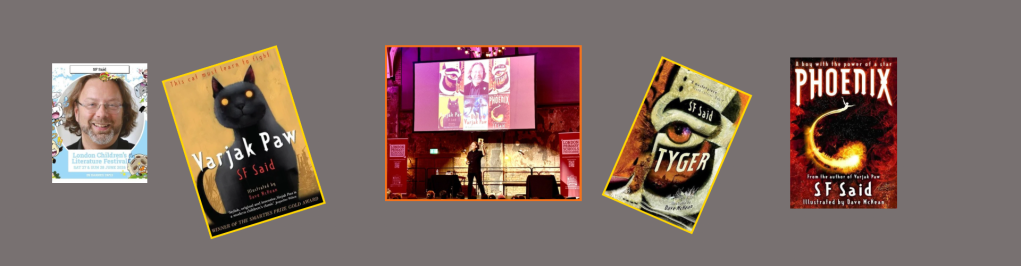
Varjak Paw, published by Random House Children’s Books
Phoenix, published by Random House Children’s Books
Tyger, published by David Fickling Books
 KIDS’ STORYWORLD